

If you are weighing SASE vs VPN for a small business, the useful question is not which acronym is newer. It is what you want checked every time someone on your team opens something. A split-tunnel VPN puts a remote laptop on the office network for the traffic you send through it. A SASE or zero-trust approach asks who and what is connecting before it lets them reach each app. Neither is the right answer for every 20-person office, and your managed IT provider can help you work out which one matches how your team works.
Below, the terms get plain definitions, then the two options go head to head on what they inspect, how access is granted, device checks and admin effort. You will end up with a short list of questions to take into a planning conversation, not a verdict.
What each option means in plain terms
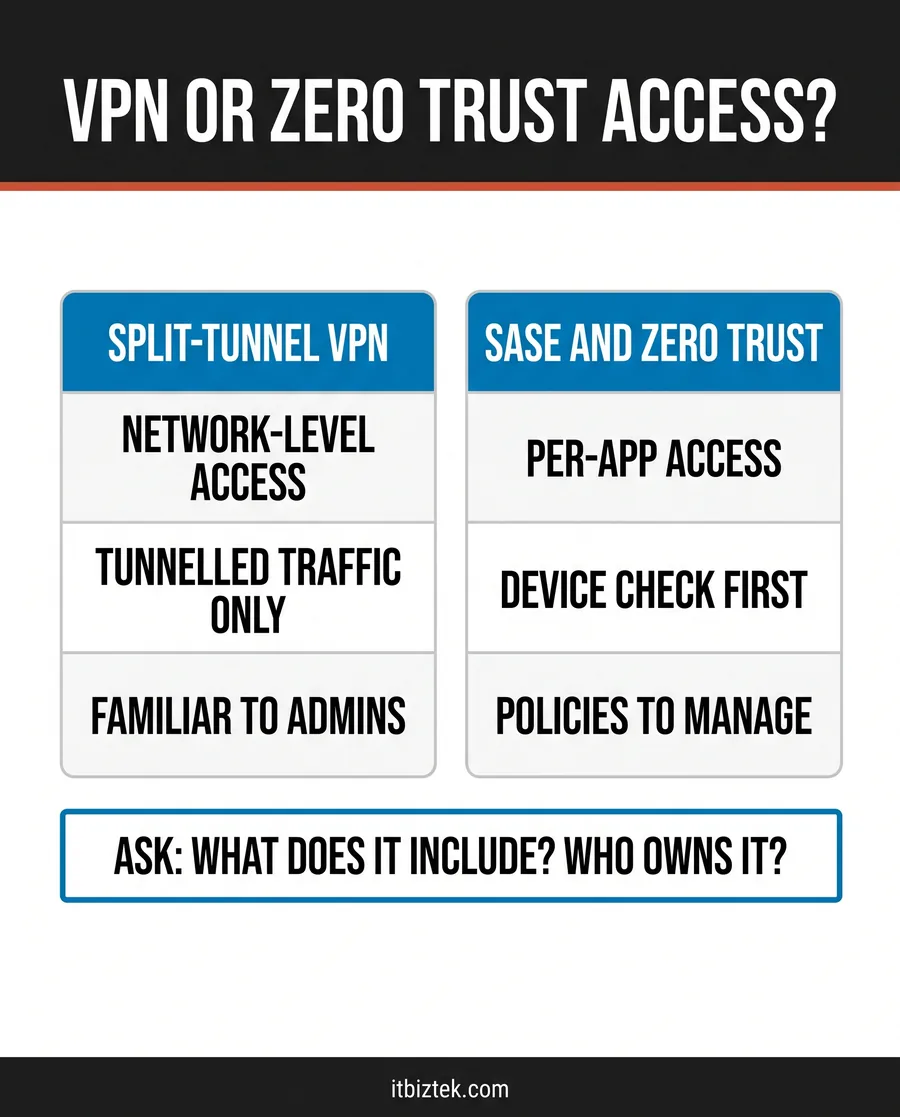
A VPN, or virtual private network, builds an encrypted tunnel between a device and your office network or a gateway. With a split-tunnel setup, only the traffic meant for company resources goes through that tunnel. Everything else, such as a video call or a news site, goes straight out to the internet from the person’s home connection. Full-tunnel is the other variation: every bit of traffic goes through the office first.
SASE stands for secure access service edge. It describes network and security functions delivered as a cloud service, so a laptop connects to a nearby service point instead of backhauling to your office. Vendors bundle different pieces under that name, so two products labelled SASE can cover quite different ground. Ask what is actually included before you compare anything.
Zero trust network access, often shortened to ZTNA, is the piece that most people mean when they say “replace the VPN.” It grants access to a specific application after checking the user and the device, rather than granting access to a whole network.
Zero trust is a model, not a product
Zero trust gets sold as a box, so it helps to go to the source. The NIST zero trust architecture publication describes zero trust as a set of principles that move defences from static, network-based perimeters to users, assets and resources. It assumes no implicit trust based solely on physical or network location, or on whether the asset is company-owned or personal. Authentication and authorization happen before a session to a resource starts.
The Canadian Centre for Cyber Security says much the same in its zero trust security model guidance (November 2022). It notes that the term does not apply to a single product, technology or architecture layer, that no application, user or device is trusted by default, and that trust is re-assessed each time a subject asks for a new resource. It also says zero trust means assuming a breach.
Quick take
A VPN and zero trust are not opposites. The Cyber Centre guidance lists VPNs among the technologies a zero trust approach can use. The real difference is what happens after the connection is made: a broad network pass, or a narrower decision per app.
SASE vs VPN for a small business, side by side
Here is SASE vs VPN for a small business, as it usually plays out. “Usually” matters: your results depend on how each one is configured and on what a given product includes.
| Question | Split-tunnel VPN | SASE with zero trust access |
|---|---|---|
| What traffic does it cover | Traffic bound for company resources goes through the tunnel; the rest leaves from the user’s own connection | Depends on the service; often covers web and app traffic through the provider’s cloud, as well as company apps |
| What gets inspected | Usually the tunnelled traffic at your gateway; the direct traffic is often not inspected by you at all | Often inspected at the provider’s edge, if those features are included and switched on |
| How access is granted | Once connected, a user commonly reaches whatever the network and firewall rules allow | Per application, after the user and device are checked |
| Device checks | Possible, but often limited to having the right credentials and client software | Commonly a built-in part of the access decision, such as checking whether the device is managed or up to date |
| Admin effort | Familiar to most IT teams; needs gateway upkeep and rule reviews | New policies to design, plus an identity setup that has to be kept clean |
| Where it tends to fit | Offices with a small set of internal systems to reach | Teams that mostly use cloud apps, or that mix managed and personal devices |
Notice what the table does not say. It does not call either option safer. A well-run VPN with tight firewall rules and multi-factor sign-in can suit a small team with a few internal servers. A poorly scoped zero trust rollout can leave gaps just as easily. The approach you choose matters less than how well it is set up and looked after.
How access is granted and devices are checked
In daily life, the biggest gap with SASE vs VPN for a small business is the scope of the pass. After a VPN login, the laptop sits on the network, and the rules on your firewall decide what it can reach. That is convenient, though NIST notes the weakness of perimeter-based models: once an attacker gets past the perimeter, further lateral movement is unhindered. The broader the pass, the more a stolen login or an infected laptop can touch.

A zero trust approach narrows the pass. The user signs in, the service checks the device, and access is granted to the application the person needs and nothing else. NIST also says that access is determined by dynamic policy, which can include the state of the requesting device, and that authorization to one resource does not automatically grant access to another. NIST adds that remote staff should not need to route back through the office network just to reach a cloud-hosted service like email.
Pro tip
Before choosing either option, list which apps your team uses and where each one lives: a server in the office, a cloud service, or both. That list usually points to the answer faster than a feature comparison does.
What the admin work looks like
For SASE vs VPN in a small business, the work after launch is part of the decision. Someone has to own it. With a VPN, that means keeping the gateway updated, reviewing who has accounts, and tidying firewall rules that piled up over time. With a zero trust service, it means writing access policies per app or group, keeping your identity directory accurate, and deciding what happens when a device fails a check.
Neither workload is large on paper, but both get neglected in a busy office. The Cyber Centre guidance lists visibility and analytics among the capabilities that sit under its zero trust model, so a plan for who watches the alerts belongs in the decision. A provider offering network monitoring services is one way to cover that, and a named internal person is another. Leaving it unassigned is the option to avoid.
People often ask
Do we have to rip out the VPN to adopt zero trust? NIST says organizations should implement zero trust principles incrementally and that most enterprises will run a hybrid of zero trust and perimeter-based security for some time. A gradual move is an accepted path.
Which kind of office fits which option
Use these as starting points for SASE vs VPN in a small business, not rules. Your own setup could land on either side of any line.
A split-tunnel VPN may fit when
- most of the work happens on a few systems that live in your office
- staff use company-managed laptops almost all of the time
- someone on the team, or your provider, already maintains the gateway and firewall rules
A SASE or zero trust approach may fit when
- most of your apps are cloud services and few sit on an office server
- people sign in from personal phones or home computers as well as company laptops
- you want different people to reach different apps, not the whole network

Plenty of offices sit in the middle. A team that keeps a file server on site but lives in cloud apps the rest of the day could run a VPN for the server and zero trust access for everything else. That mixed pattern matches the hybrid setup NIST describes. Your remote work setup also plays a part, since home routers and personal devices are part of the picture whichever option you pick.
Questions to settle before you decide
A short planning session beats a long feature list. The SASE vs VPN call for a small business rests on these answers, so work through them in order and bring them to whoever is helping you.
- Which apps and data does the team use, and where does each live?
- Who connects, from what kinds of devices, and which of those devices does the business manage?
- Which systems would hurt most if one account were taken over?
- Who will own policy changes, access reviews and alerts after launch?
- What does the provider’s product actually include under its SASE label, and what would you still need to add?
The fifth question deserves extra time. If you want a neutral review of how your team connects today, a cyber security assessment maps the current setup and gives the decision a factual base instead of a vendor’s pitch.
Good to know
This article is general information about network access models, not security advice for your specific business. Products and features differ, and standards guidance changes over time. Confirm the right approach for your systems with a qualified IT security professional before you change how your team connects.
Download the free quick guide
A short checklist of the questions to answer before choosing a VPN or a zero trust approach for your team.
Frequently asked questions
Can we run a VPN and zero trust access together?
Yes, and many offices do. The Canadian Centre for Cyber Security lists VPNs among the technologies zero trust can use, and NIST expects most organizations to run a mix of zero trust and perimeter-based security for some time. A common pattern keeps the VPN for an on-site server and moves cloud apps to per-app access.
Does zero trust mean we can remove our firewall?
No. NIST describes zero trust as a change in where trust decisions are made, and it expects a hybrid with perimeter-based controls in many organizations. Your firewall still does a job at the office edge. Which rules it needs may change as more apps move to per-app access.
Is SASE the same thing as zero trust?
Not quite. Zero trust is a security model, and the Cyber Centre stresses that it is not a single product. SASE is a way of delivering network and security services from the cloud, and some SASE offerings include zero trust access. Ask any provider which features their package covers and how each is configured.
Take the answers to a planning conversation
Once you have your app list, your device list and your five answers, the SASE vs VPN choice for a small business gets much narrower. If you would like a second pair of eyes on it, talk to our team and bring what you have so far.