

🎙 Listen to the Podcast
The IT Leadership Gap That’s Slowing Toronto Businesses Down
Here’s a scenario most Toronto business owners recognize. You have solid IT support handling day-to-day issues, but nobody is sitting down and asking the bigger questions: Where does technology fit into your three-year growth plan? Are you overspending on software you don’t need? Is your current infrastructure going to hold up when you double headcount? What happens if you get hit with ransomware?
Those are CIO-level questions. And for the majority of Toronto businesses with under 150 employees, the answer is also a familiar one: nobody’s asking them. There’s no budget for a full-time Chief Information Officer, and day-to-day IT management doesn’t leave room for strategic thinking even when someone capable is in the seat.
That’s the problem a vCIO – virtual Chief Information Officer – solves. It’s a model that’s become increasingly common among Toronto’s mid-market and growth-stage businesses, and it’s worth understanding what it actually delivers before deciding whether it’s the right fit for your organization. Managed IT services with a vCIO component give you the strategic layer that pure break-fix or reactive IT support simply can’t provide.
What a vCIO Actually Does
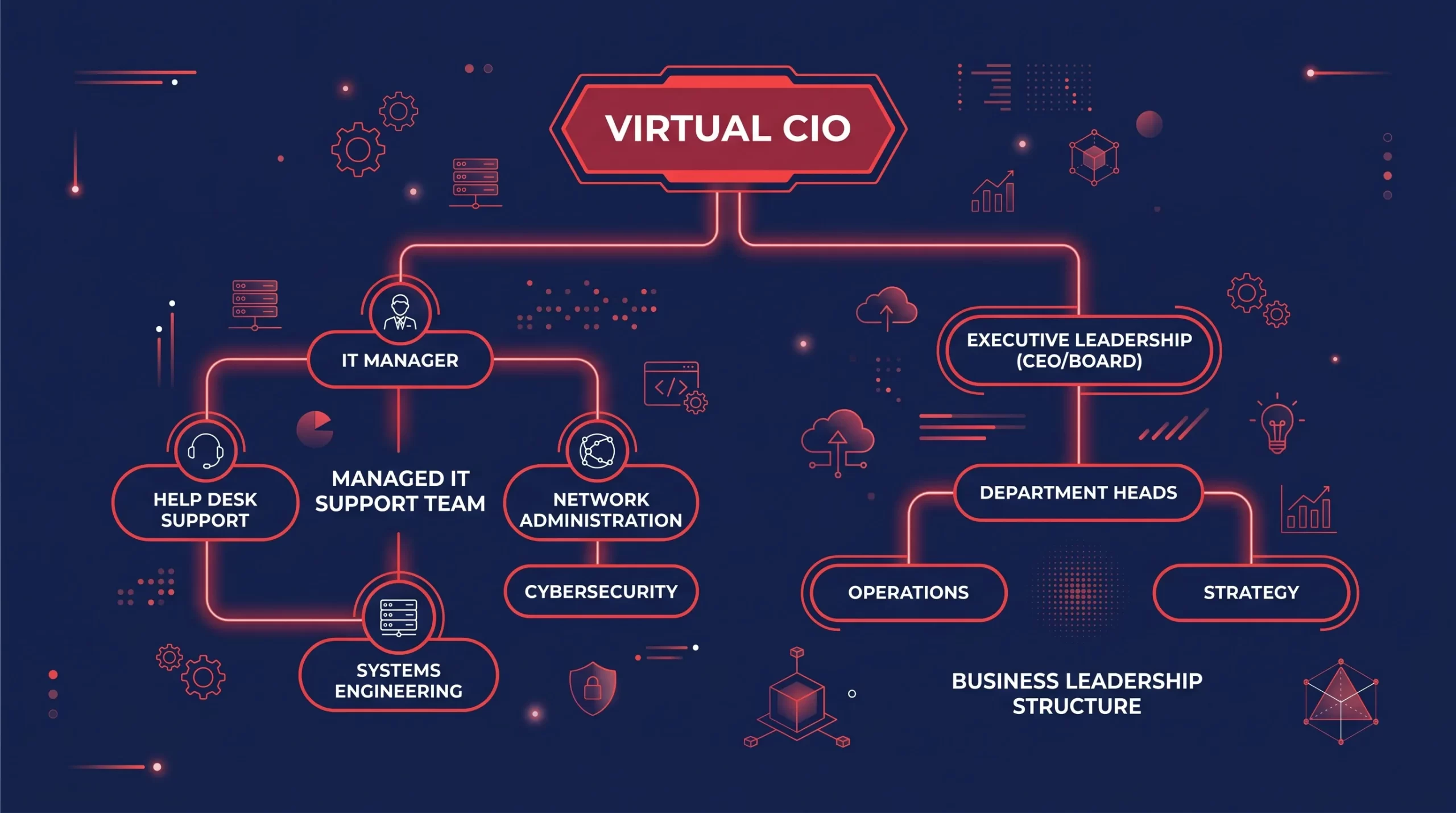
A vCIO is a senior-level technology advisor who serves your organization on a fractional basis – typically a set number of hours per month – rather than as a full-time employee. The role covers strategic planning, vendor management, budget oversight, risk assessment, and technology roadmapping.
Concretely, this looks like:
- Technology roadmapping – Developing a 1 to 3 year plan for your IT infrastructure that aligns with your business growth targets. If you’re planning to open a second location, add 30 staff, or shift to a hybrid work model, your infrastructure needs to evolve ahead of those changes, not in reaction to them.
- IT budget planning and oversight – Building and reviewing the annual IT budget, identifying where money is being wasted on redundant tools or underused licenses, and making the case for investments that will generate measurable ROI.
- Vendor management and contract review – Evaluating technology vendor proposals and contracts from a position of expertise. Most business owners lack the context to assess whether an IT vendor’s pricing and terms are competitive or whether the proposed solution is genuinely fit for purpose.
- Cybersecurity governance – Overseeing the cybersecurity posture of the business at a strategic level: ensuring policies exist, are tested, and reflect current threat landscapes. This includes reviewing cyber insurance requirements, managing compliance obligations, and coordinating incident response planning.
- Digital transformation guidance – Evaluating and advising on technology decisions that affect business processes: cloud migration, ERP implementation, automation initiatives, and the integration of new platforms with existing systems.
- Board and executive communication – Translating technology risk and investment decisions into language that resonates with non-technical executives and board members. This function is often missing in SMBs even when IT expertise exists internally.
vCIO vs. Full-Time CIO: What Toronto Businesses Are Actually Choosing Between
A full-time CIO in the Toronto market typically commands a salary between $180,000 and $280,000 per year, plus benefits, equity, and overhead. According to data from Robert Half Canada’s annual salary guide, senior IT leadership roles in Toronto have seen consistent compensation increases over the past three years as demand for tech-fluent executives outpaces supply.
For a business with 20 to 100 employees, that investment only makes sense if the CIO role is genuinely full-time. And it rarely is at that scale. A vCIO arrangement through a managed IT provider typically costs between $1,500 and $5,000 per month depending on the scope of engagement – a fraction of the in-house alternative, and without the hiring risk, onboarding cost, or turnover exposure.
The tradeoff is availability. A full-time CIO is embedded in your organization daily and can respond instantly to emerging situations. A vCIO works on a scheduled basis and may not be available for same-day crises. This is why vCIO services work best alongside a solid managed IT support structure that handles day-to-day and incident response, while the vCIO focuses on the strategic layer.
When Does Your Toronto Business Actually Need a vCIO?
Not every business needs one immediately. But most growing Toronto businesses hit inflection points where the absence of strategic IT leadership starts costing real money and creating real risk. Here are the clearest signals:
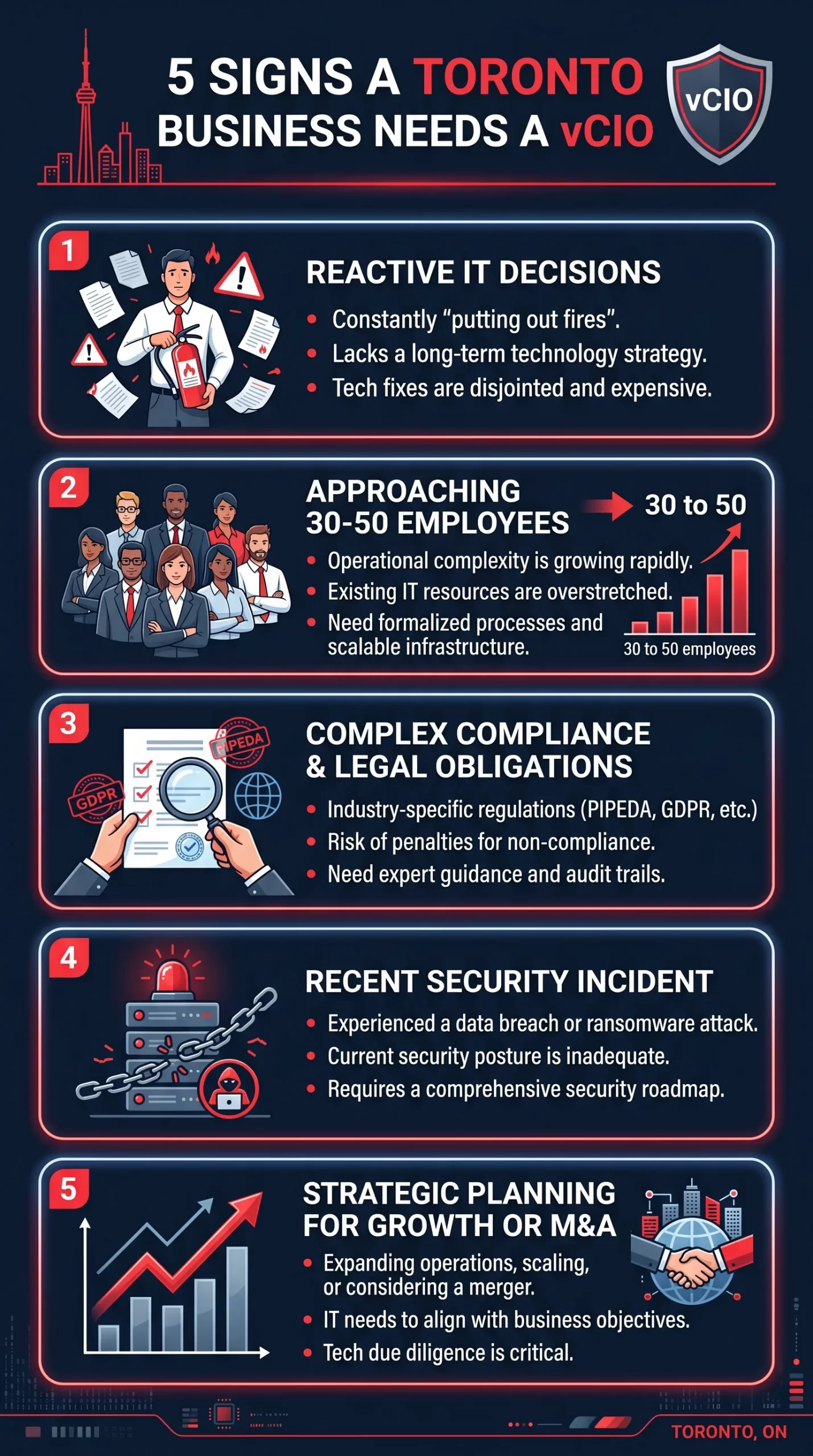
You’re Making IT Decisions Reactively
If your technology decisions are driven by what breaks, what a vendor is promoting, or what your cheapest-available option looks like rather than a deliberate plan, you’re accumulating technical debt. This debt compounds: outdated systems require more maintenance, create more security exposure, and eventually need expensive emergency replacement rather than managed, budgeted migration. A vCIO brings a planning discipline that replaces reactive decision-making with intentional architecture.
You’re Approaching 30 to 50 Employees
This is typically the scale at which ad-hoc IT management breaks down. Below this threshold, most technology decisions can be made by whoever is most technical on staff, often the owner or an operations manager. Above it, the complexity of managing endpoints, security policies, software licensing, and regulatory compliance across a larger organization requires someone thinking about systems architecture rather than individual problems. Many Toronto businesses engage a vCIO for the first time when they cross this headcount threshold.
You Have Compliance Obligations You Don’t Fully Understand
Businesses handling personal health information fall under provincial and federal privacy legislation. Financial services firms face OSFI guidance. Any company doing business with US customers needs to think about state-level privacy laws. Professional services firms holding client data have duty-of-care obligations. A vCIO maps your compliance landscape, identifies gaps, and helps implement the controls required to meet your obligations – work that’s difficult to do correctly without specialized expertise.
You’ve Had a Security Incident or Near-Miss
A ransomware attempt, a successful phishing attack, a data breach – or even just learning that your competitor was hit with one – is often the moment Toronto business owners start thinking seriously about IT governance rather than just IT support. A vCIO conducts a proper security risk assessment, helps implement a cybersecurity framework appropriate for your size and industry, and builds the policy infrastructure (incident response plan, acceptable use policy, backup and recovery testing) that transforms your security posture from reactive to managed.
You’re Planning Significant Growth or a Transaction
If you’re raising capital, pursuing an acquisition, preparing for M&A due diligence, or planning a major expansion, technology infrastructure gets scrutinized. Acquirers and investors examine IT systems, cybersecurity policies, and technology debt as part of their diligence. Having a vCIO who can present a coherent technology strategy and documented security posture materially strengthens your position in a transaction process.
Understanding the vCIO Role in Practice
This video explores how strategic IT leadership creates measurable business value for small and mid-sized companies – beyond just keeping the lights on.
Important Information
Disclaimer: This article is for general informational purposes only and does not constitute legal, financial, or professional IT advice. Technology costs, compensation benchmarks, regulatory requirements, and product availability change frequently. ITBizTek is not liable for outcomes from actions taken based on this content. Always consult qualified professionals for advice specific to your business situation. Compliance requirements vary by industry and jurisdiction – engage a qualified compliance professional for guidance on your specific obligations.

Frequently Asked Questions About vCIO Services
Download the Quick Guide (PDF)
Sources and References
- Robert Half Canada – Technology salary guide: senior IT leadership compensation in Toronto
- Canadian Centre for Cybersecurity – Baseline cyber security controls for small and medium organizations
- Gartner Research – CIO and technology leadership trends and priorities
Ready to Talk About vCIO Services for Your Toronto Business?
If any of the scenarios in this article sound familiar – reactive IT decisions, uncertainty about your technology roadmap, compliance obligations you’re not fully addressing – it’s worth having a conversation about what strategic IT leadership could look like for your specific situation.
ITBizTek works with Toronto and GTA businesses to deliver managed IT and vCIO services that align technology with business goals. No jargon, no upselling, no generic advice. Just a clear-eyed look at where you are and a practical plan to get where you’re going. Get in touch today to start the conversation.