

What IT Consulting Actually Does
Small businesses across Canada keep adding technology to stay competitive, and most owners are not equipped to manage all of it themselves. That is not a knock on anyone. Running the business is already a full-time job, and IT is a second full-time job most people never signed up for. IT consulting exists to close that gap: an outside advisor who figures out what technology you actually need, helps you pick it, and helps you put it in place without pulling your attention away from the business itself.
Core Services
IT consultants typically handle a specific set of tasks rather than everything under the sun:
- Assessing your current IT setup and finding the gaps
- Recommending solutions suited to your business, not a generic package
- Leading the setup of new systems and software
- Supporting the change management that comes with new tools, meaning the training and adjustment period, not just the install
- Ongoing maintenance, support, and staff training after the rollout
That combination lets a small business get expert input without carrying the overhead of a full-time hire.

Why Small Businesses Turn to IT Consulting
Expertise You Do Not Have In-House
Most small businesses cannot justify a full-time specialist in cybersecurity, data recovery, and infrastructure planning all at once. An IT consultant brings that range of expertise as a package and helps you keep pace with changes that would otherwise mean hiring three different people.
Cost-Effective Compared to a Full IT Department
Consulting is usually structured so you pay for what you use, rather than carrying a full department’s salaries and overhead year round. That is not a claim that it is free or trivial. It is a different cost structure, one that tends to suit a business whose IT demands do not justify a full internal team yet. For a clearer picture of what that looks like for your business, our IT consulting services page breaks down what is included.

Building an IT Strategy That Matches Your Business
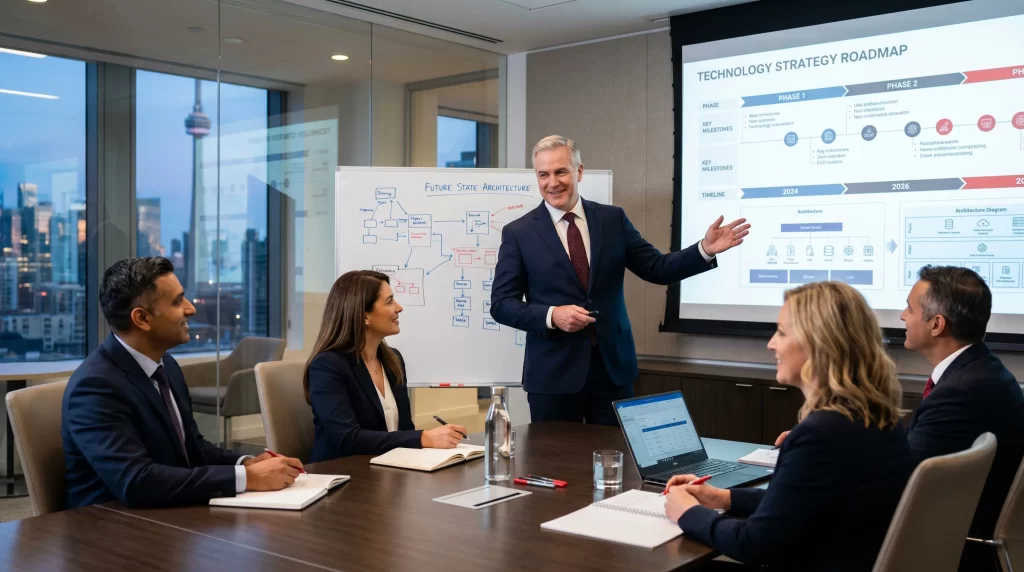
Good IT consulting is not just fixing what is broken. It starts with a strategy that ties your technology spending to what your business is actually trying to do.
Aligning Technology with Business Goals
The first step is usually a straightforward look at what you already have: servers, cloud usage, software, how well it is managed, and how much of it is actually pulling its weight. From there a consultant can tell you what needs attention now, what can wait, and what should be replaced rather than patched again. That kind of assessment covers your applications, your infrastructure, and how it is supported day to day.
Planning for What Comes Next
Technology does not stay current on its own. Part of the value of consulting is making sure your systems can grow with the business instead of becoming the thing that holds it back in two years. That is a planning exercise as much as a technical one.

IT Consulting and Data Security
Cyberattacks and data breaches are a real threat to small businesses, not just the large ones you read about. IT consulting is often where a small business gets its first honest look at how exposed it actually is.
Cybersecurity and Data Backup
A consultant starts by reviewing your network risks, then builds a security plan around what they find, backup and recovery included, along with training for staff on recognizing common threats. Backups that are tested and ready to use matter more than backups that simply exist on a schedule somewhere. Our cybersecurity services cover this in more detail if data protection is the reason you are reading this.
IT Consulting and Productivity
Bad technology has a cost that rarely shows up on a spreadsheet: the minutes lost every day to slow systems, tasks that stall because the software was not built for how your team actually works, or meetings that run long because the tools do not cooperate.
Streamlining Day to Day Work
An IT consultant looks at where your current setup gets in the way and matches your software and hardware to how your team actually operates now, not how it operated five years ago. The goal is simple: less friction between your staff and the work they are trying to do.
Tools for Hybrid and Distributed Teams
Remote and hybrid work are not the novelty they were a few years back. They are just how a lot of teams operate now. Consultants help pick collaboration tools that fit that reality, so people can work from wherever they need to and still get decisions made without a dozen email threads. Done right, this also makes a business more adaptable when circumstances change again, and they will.
IT Consulting vs an In-House IT Team
Most small businesses do not have a full in-house IT team, mainly because of cost and available talent, not because they would not want one. IT consulting fills that gap: expert help when you need it, without the overhead of full-time salaries.
The tradeoffs run in both directions:
- An in-house team knows your business inside out and is there every day, but comes with fixed salary and overhead costs regardless of how much IT work there actually is that month
- A consulting relationship costs less on average and gives you access to a wider range of specialized skills, but you are working with a partner rather than an employee who lives inside your culture full time
- Scaling an in-house team up or down takes time and hiring; scaling a consulting relationship is usually just a conversation
Neither option is automatically right for every business. For a lot of small and mid-sized businesses, consulting wins simply because the IT workload does not justify a full-time department yet, and managed IT services can fill the ongoing day-to-day gap once the strategy is set.
Scaling IT as You Grow
The other place consulting earns its keep is growth. A consultant helps you choose technology that can grow with the business, so you are not ripping out and replacing your entire stack every time you add staff or open a new location. That means fewer disruptive overhauls and more predictable costs as you scale, plus the flexibility to adjust support up or down as your needs change instead of carrying a fixed headcount either way.
Talk to ITBizTek About IT Consulting
If you have questions about what IT consulting would actually look like for your business, get in touch. We work with small and mid-sized businesses across Toronto and the GTA, and we would rather give you a straight answer than a sales pitch.