

The pace of modern IT moves faster than ever, and with that speed comes complexity. Businesses once operated with simple server setups, basic backups, and a handful of software tools. Now, networks span multiple cloud platforms, applications talk to each other across continents, and data lives in dozens of places at once. That growth has given companies enormous capabilities, but it has also made IT disaster recovery for businesses far more challenging.
Modern Infrastructure Makes It Complicated
The first hurdle comes from infrastructure itself. Virtual machines, containers, hybrid clouds, and SaaS applications are now standard. Each layer introduces a new dependency. A server outage in one region might not just take down a single application, it can have a ripple effect across multiple systems. Recovery isn’t as simple as flipping a switch, now we have to pinpoint the exact issue in tangled web of infrastructure.
The Explosion of Data and Speed Requirements

Data volume has exploded, and not just in size. The speed at which data flows is staggering. Companies generate terabytes of transactional data every day. Some of it is sensitive, some is mission-critical, and some is regulatory. IT disaster recovery for businesses now has to account for both speed and compliance. Backups can’t just exist just for the sake of having them, they actually need to be complete and accessible in real time.
Challenges Across Endpoints
Another challenge comes from the diversity of endpoints. Employees work on laptops, desktops, mobile devices, and increasingly through remote access to virtual environments. Each endpoint is a potential weak point. It only takes a ransomware attack on one device to gain access and spread across an entire network before anyone realizes what happened. Coordinating recovery across hundreds or thousands of endpoints complicates even the most carefully crafted disaster plans.
Human Factors in Recovery
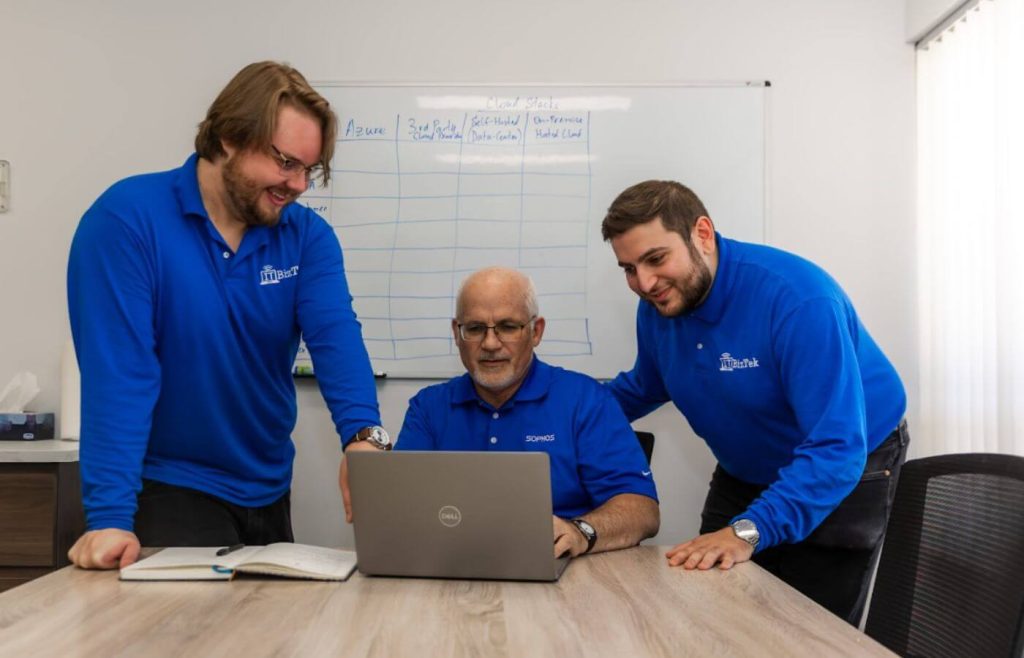
IT staff often specialize in certain platforms or tools. When a disaster strikes, the team may need skills outside their usual wheelhouse, often under high pressure. Without clear playbooks and cross-training, recovery slows down. IT disaster recovery for businesses now requires not just technology but also a strategy for the recovery team. At ITBiztek, all of our team members are cross-trained, with years of experience solving IT issues. So when you choose our IT disaster recovery service for businesses, you’ll be getting a team that won’t put your data in jeopardy.
Cloud Strategies and Their Pitfalls

Cloud solutions were supposed to simplify recovery, but they have introduced new pitfalls. Multi-cloud strategies give flexibility and resilience, but they also mean multiple interfaces, policies, and failover mechanisms. A recovery plan for one cloud might not translate to another. Businesses need detailed mapping of dependencies and failover testing for each environment.
Cybersecurity Threats
Cybersecurity threats have added another layer of complexity. Malware, ransomware, and targeted attacks have become highly sophisticated. Attackers know that businesses rely on cloud backups and replication, so they target those systems too. IT disaster recovery for businesses now involves anticipating attacks that can compromise backups themselves. Offline backups, immutable snapshots, and segmented networks have become standard defenses, but they require planning and maintenance that can’t be ignored.
Regulatory Requirements
Regulations complicate things further. Different industries have different compliance requirements. Healthcare, finance, and government agencies face strict rules around data retention, access, and reporting. A recovery plan must align with these rules or risk legal consequences.
Automation and Testing
Automation helps, but it can backfire if not managed carefully. Scripts that replicate data, spin up virtual environments, or apply patches save time, but they also introduce risk if they run incorrectly during a disaster. Automated systems must be tested, monitored, and updated continuously.
Testing is another point where modern IT has made recovery harder. It’s one thing to have a recovery plan, it’s another to prove it works. Simulating real-world conditions across hybrid environments, diverse applications, and distributed teams is difficult. Businesses often skip testing due to time or budget pressures, leaving gaps that only appear during an actual incident. IT disaster recovery for businesses demands rigorous, ongoing testing to validate every step and component.
Communication and Coordination
In complex IT environments, different teams may use different tools, and information can get siloed. During an outage, everyone needs the same updates in real time. Without coordination, teams may attempt conflicting actions, slowing recovery or making problems worse. Modern recovery is as much about people and process as it is about technology.
Building Resilience in Modern IT
All these factors mean that IT disaster recovery for businesses is no longer a simple technical challenge. It’s evolved into something much larger, with now needing more thorough planning and testing. Recovery plans that worked a few years ago are often insufficient today.
The good news is that modern tools and strategies exist to address these challenges. Advanced monitoring, orchestration platforms, immutable backups, and automated failover systems make recovery feasible even in complex environments. But you don’t just implement them once and you’re done, you need to do consistent maintenance, checks, and updates to make sure they’re ready to help when you need it.
IT disaster recovery for businesses is complicated, but with resources on developing an IT recovery plan and help from our team of professionals, it’s no sweat. Organizations that invest time and resources into planning, testing, and maintaining recovery strategies will find they can respond to disruptions faster, protect critical data, and minimize downtime.