
A growing retail business with three locations across the Greater Toronto Area – one in downtown Toronto, one in Mississauga, and one in Vaughan was struggling with fragmented IT systems.
Each location had been set up independently over time, resulting in inconsistent hardware, different firewall brands, separate Wi-Fi configurations, and no centralized oversight.
As they expanded, IT complexity grew faster than revenue.
The Challenge: Fragmented Systems Across Locations
The business owner reached out after experiencing repeated operational disruptions, including:
- POS system outages at one store while others functioned normally
- Wi-Fi instability impacting payment processing
- Inconsistent cybersecurity protections between locations
- No visibility into network performance
- Different IT vendors handling each store
The tipping point came when an internet outage at one location halted sales for nearly half a day and there was no failover or remote visibility to troubleshoot it quickly.
They needed centralized IT management without hiring an internal IT department.
Our Process
Multi-Location IT Audit
We conducted a full IT infrastructure assessment across all three stores, reviewing:
- Firewall and router configurations
- ISP contracts and redundancy options
- POS system network dependencies
- Wi-Fi segmentation (guest vs. internal traffic)
- Endpoint protection and patching status
- Backup and recovery capabilities
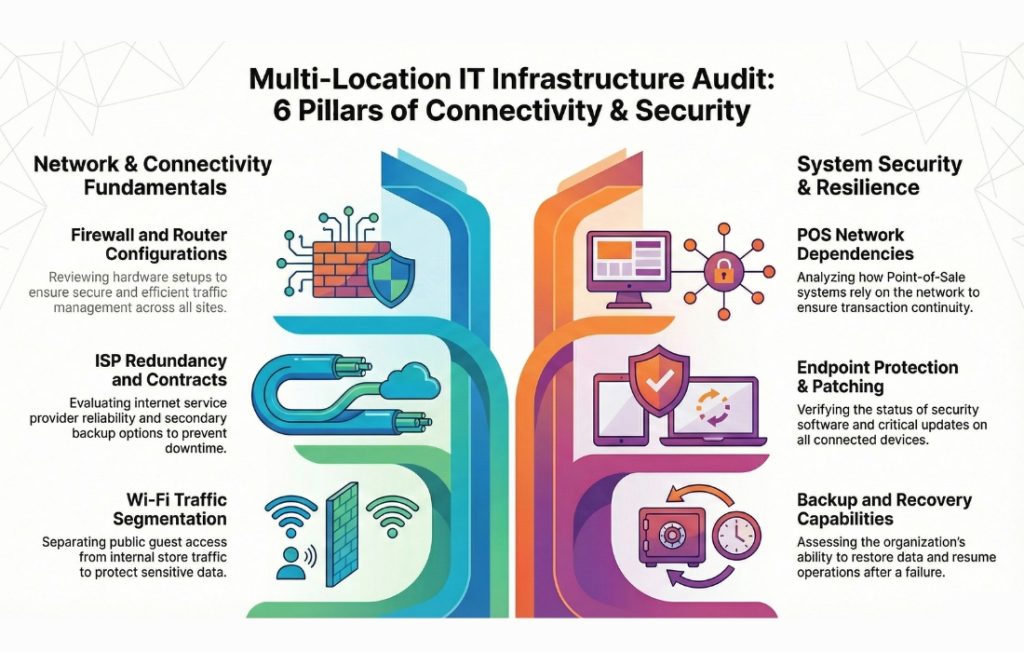
Key finding: Each location had different security standards and no unified management.
Unified Firewall & Network Stack Deployment
To standardize infrastructure, we:
- Replaced mixed-brand firewalls with a unified, enterprise-grade firewall solution across all stores
- Standardized network architecture
- Implemented secure VLAN segmentation (POS, staff devices, guest Wi-Fi)
- Enabled encrypted site-to-site connectivity between locations
This eliminated configuration inconsistencies and strengthened overall security posture.
Centralized Cloud Management
Next, we moved management into a centralized cloud dashboard that allowed:
- Real-time visibility into all three locations
- Remote troubleshooting
- Automated firmware and security updates
- Standardized security policies across all stores
Now, if an issue occurs in Mississauga, it can be diagnosed and resolved without waiting for on-site support.
24/7 Monitoring & Proactive Alerts

We implemented proactive monitoring across:
- Internet connectivity
- Firewall performance
- POS network traffic
- Device health
- Security threats
Instead of reacting to outages after staff reported them, alerts are triggered immediately often before staff even notice a disruption.
The Results
Within 90 days, the retail business experienced:
- 60% reduction in troubleshooting time
- Zero full-day outages
- Improved POS transaction stability
- Stronger cybersecurity posture across all locations
- Simplified vendor management (single IT partner)
- Predictable monthly IT budgeting
Most importantly, management gained peace of mind knowing all locations were protected, monitored, and standardized.
This kind of transformation is exactly where structured managed IT services make the biggest impact. Centralized monitoring, standardized security, and scalable infrastructure aren’t just technical upgrade, they’re operational safeguards that protect revenue as you grow.
When IT is aligned across every location, expansion becomes simpler, downtime becomes rare, and technology becomes an asset rather than a liability.