

How Government Programs Are Finally Making AI Adoption Practical for Small Businesses
If you’re a small or mid-sized business owner in Canada, you’ve probably heard the AI hype for years. Automation. Analytics. Productivity gains. Smarter decisions.
And you’ve probably thought the same thing many of my clients tell me:
“This sounds great, but it feels built for big enterprises, not businesses like ours.”
That’s exactly why the Canadian government’s SME AI Adoption Blueprint, released following the 2025 G7 meetings in Kananaskis, Alberta, matters so much. It’s one of the first national-level acknowledgements that AI adoption for SMEs must be practical, affordable, and aligned with real-world business constraints.
Let’s break down what this actually means for Canadian SMEs and how you can take advantage of it without overextending your budget or your team.
Why This Blueprint Matters More Than Past AI Announcements
According to the federal report, AI adoption among Canadian SMEs is still relatively low. Roughly 12.5 percent of smaller Canadian companies report using AI, compared to much higher adoption rates among large enterprises.
That gap exists for very real reasons:
- Limited budgets
- Legacy systems
- Lack of in-house expertise
- Uncertainty around ROI and risk
- Fear of disrupting day-to-day operations
What’s different about this initiative is that it acknowledges those barriers instead of ignoring them. The blueprint explicitly recognizes that SMEs cannot adopt AI the same way Fortune 500 companies do. That is a big shift.
You can find the full report on Innovation, Science and Economic Development Canada’s website under the “SME AI Adoption Blueprint” released after the 2025 G7 Industry, Digital and Technology Ministers’ Meeting.
The Government’s Message Is Clear: AI Is Not One-Size-Fits-All
One part of the report I strongly agree with is the idea that AI adoption is not linear.
The framework identifies four types of SME AI adopters:
- AI Novices experimenting with off-the-shelf tools
- AI Optimizers using AI across multiple workflows
- AI Explorers building customized or sector-specific solutions
- AI Transformers embedding AI across their entire operation
Most Canadian SMEs I speak with fall into the Novice or Optimizer category. And that’s perfectly fine.
The mistake I see businesses make is trying to jump straight to “AI transformation” without the digital foundations to support it.
Where SMEs Should Actually Start With AI
Here’s the honest advice I give clients at ITBizTek.
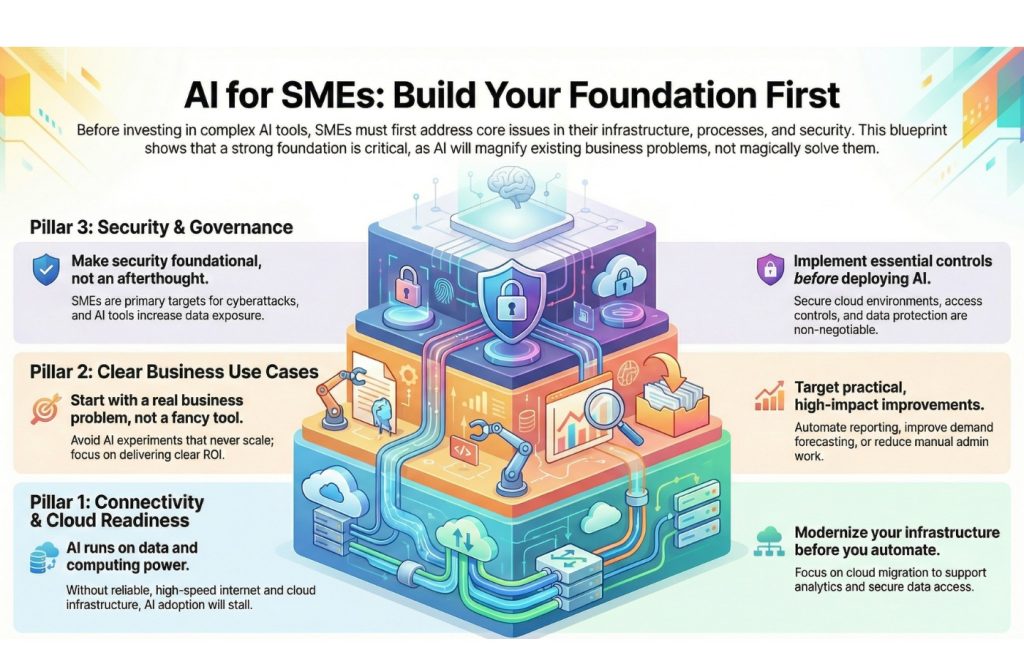
If your data is messy, your systems don’t talk to each other, or your infrastructure is fragile, AI will magnify those problems instead of solving them.
The federal blueprint emphasizes three foundational areas that matter far more than fancy tools.
1. Connectivity and Cloud Readiness
AI runs on data and compute power. Without reliable, high-speed internet and cloud infrastructure, adoption stalls quickly.
This is why government programs are prioritizing:
-
Improved broadband access
-
Affordable cloud services
-
Shared compute resources for SMEs
From our side, this is where cloud consulting and cloud migration services come in naturally. Before AI, we help clients modernize their infrastructure so it can actually support analytics, automation, and secure data access.
2. Clear Business Use Cases, Not Experiments for the Sake of AI
The report repeatedly warns about AI pilots that never scale. That happens when businesses start with tools instead of problems.
Good SME use cases are boring in the best way:
-
Automating reporting
-
Improving demand forecasting
-
Enhancing customer support response times
-
Reducing manual admin work
-
Optimizing inventory or scheduling
At ITBizTek, we often start with an IT and digital readiness assessment to identify where AI could realistically deliver ROI within 3 to 6 months. That aligns perfectly with the government’s recommendation to focus on phased, low-risk adoption.
3. Security and Governance From Day One
One thing the blueprint gets right is its emphasis on secure, responsible, and trustworthy AI.
SMEs are now primary targets for cyberattacks, and AI tools often interact with sensitive data. Without proper controls, businesses risk compliance issues and data exposure.
This is where managed IT services and cybersecurity services are not optional. They are foundational. Secure cloud environments, access controls, endpoint protection, and governance frameworks must be in place before AI touches core systems.
AI Adoption Is Also a People Problem, Not Just a Tech Problem
Another refreshing part of the government’s approach is its focus on skills and culture.
Roughly half of SMEs surveyed across G7 countries report that their employees lack the skills to use generative AI effectively. That doesn’t mean hiring a team of data scientists.
It means:
- Building basic AI literacy
- Showing teams how AI supports their work rather than replacing it
- Training staff to use tools responsibly
We often support this through ongoing IT support, training, and change management, helping teams adopt new tools without resistance or fear.
What SMEs Should Do Right Now
If you’re reading this and wondering what the next step should be, here’s my straightforward advice.
-
Assess your digital foundations
Understand your infrastructure, data quality, and security posture. -
Start with one high-impact use case
Pick something measurable and business-critical. -
Leverage government-aligned programs and incentives
Many upcoming funding and advisory initiatives are designed to lower risk for SMEs. -
Partner instead of building everything in-house
Managed IT and cloud partners exist so you don’t have to hire internally for every capability.

AI is not about keeping up with trends. It’s about staying competitive in a market where productivity, speed, and decision-making increasingly define success.
Canada’s message to SMEs is finally realistic. Adopt AI, but do it safely, strategically, and at your own pace.
If you do that, AI stops being intimidating and starts becoming a genuine growth lever. Get in touch with us today for strategically adopting AI for your business!
By Danny Sadovsky- Founder and CEO, ITBizTek